



Electricity is used in many of the devices to create comfort in your home. Look around. Air conditioning, solar, hot water tanks, stoves, ovens, – they all run on electricity.
It is critical to have a variety of safety mechanisms to protect against fire and electric shocks should any of these devices malfunction. We can install and upgrade a number of safety devices such as circuit breakers, fuses and smoke alarms.
Both fuses and circuit breakers serve as the point of contact between the electricity network and a specific building.
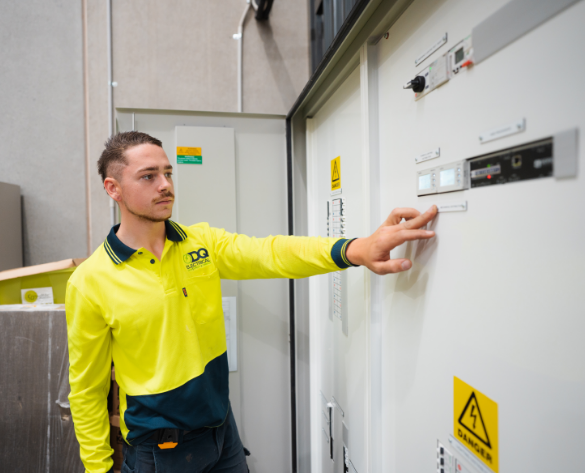
Circuit breakers are the standard in modern switchboards, providing a safer and more reliable alternative to traditional ceramic fuses.
Rather than being damaged by an overload or fault, a circuit breaker automatically trips, cutting off the electricity supply to protect the circuit. Once the fault has been identified and resolved, it can simply be reset—there’s no need to replace any components.
Circuit breakers are also considered safer because they are designed to provide consistent protection and cannot be bypassed in the same way as a fuse by installing an incorrect replacement.
There are three main types of circuit breakers:
Thermal circuit breakers – Trip in response to heat generated by an overload.
Magnetic circuit breakers – Trip instantly when a short circuit or high fault current creates a strong magnetic field.
Thermal-magnetic circuit breakers – Combine both technologies, protecting against both overloads and short circuits. This type offers similar protection characteristics to a slow-blow fuse while providing the convenience of being reset after a fault.
Got questions about an electrical job at your home?
Got questions about an electrical job at your home?
A safety device, also known as a Residual Current Device (RCD) or safety switch, is designed to protect people from electric shock. It continuously monitors the flow of electricity and automatically switches the power off within milliseconds if it detects electricity leaking to earth—such as through a damaged appliance, faulty wiring, or a person coming into contact with a live electrical source.
According to the National Coronial Information System, there are approximately 20 preventable electrocution deaths in Australia each year, with more than half occurring in the home. Many of these tragedies could be prevented with the installation of safety devices, with electrical appliances being one of the leading causes of electrocution.
Safety devices provide an additional layer of protection for your home or workplace. If a current leakage is detected, the device immediately cuts off the power before serious injury can occur. By stopping the flow of electricity through a person, a safety device significantly reduces the risk of electric shock, severe burns, and electrocution.
For a relatively small investment, installing safety devices can greatly improve the safety of your family, employees, and anyone using the electrical installation.
Yes, both protect lives – but there are some significant technical differences. Every home has a main switch board with a breaker panel, which will house circuit breakers or fuse types. The main difference between the two is that a circuit breaker can be reset and used over and over again while a fuse is a one-shot deal, with a fuse wire that has to be replaced by a qualified person.
While it may not be mandatory, upgrading from older ceramic fuses to modern circuit breakers is highly recommended. Circuit breakers provide better protection against overloads and electrical faults, helping to reduce the risk of electrical fires. Unlike fuses, they can simply be reset after a fault instead of being replaced.
If your switchboard still has ceramic fuses, upgrading to a modern switchboard with circuit breakers and safety switches (RCDs) is one of the best ways to improve your home’s electrical safety and provide peace of mind for your family.
Did you know according to the National Coronial Information System, there are approximately 20 preventable deaths in Australia every year from electrocution, with more than half occurring in the home. Most of these tragedies are preventable, with electrical appliances the second-most common cause of electrocution.
Electric shock can be avoided by using safety devices. For only a small amount of outlay, you can protect your employees and family members to a higher degree, than your current set up.
When a current leakage is detected by the device it will cut off the power. By stopping the current flowing through a person, the device prevents electric burns or electric shock which can lead to serious injury or death.
Yes, both protect lives – but there are some significant technical differences. Every home has a main switch board with a breaker panel, which will house circuit breakers or fuse types. The main difference between the two is that a circuit breaker can be reset and used over and over again while a fuse is a one-shot deal, with a fuse wire that has to be replaced by a qualified person.
Rewiring your household does not always increase its value. Nevertheless, recognising that the electrics are fully updated and secure makes it more appealing to prospective buyers and much safer for your family. There is no value to put on such peace of mind.
Did you know according to the National Coronial Information System, there are approximately 20 preventable deaths in Australia every year from electrocution, with more than half occurring in the home. Most of these tragedies are preventable, with electrical appliances the second-most common cause of electrocution.
Electric shock can be avoided by using safety devices. For only a small amount of outlay, you can protect your employees and family members to a higher degree, than your current set up.
When a current leakage is detected by the device it will cut off the power. By stopping the current flowing through a person, the device prevents electric burns or electric shock which can lead to serious injury or death.
Yes, both protect lives – but there are some significant technical differences. Every home has a main switch board with a breaker panel, which will house circuit breakers or fuse types. The main difference between the two is that a circuit breaker can be reset and used over and over again while a fuse is a one-shot deal, with a fuse wire that has to be replaced by a qualified person.
Rewiring your household does not always increase its value. Nevertheless, recognising that the electrics are fully updated and secure makes it more appealing to prospective buyers and much safer for your family. There is no value to put on such peace of mind.